
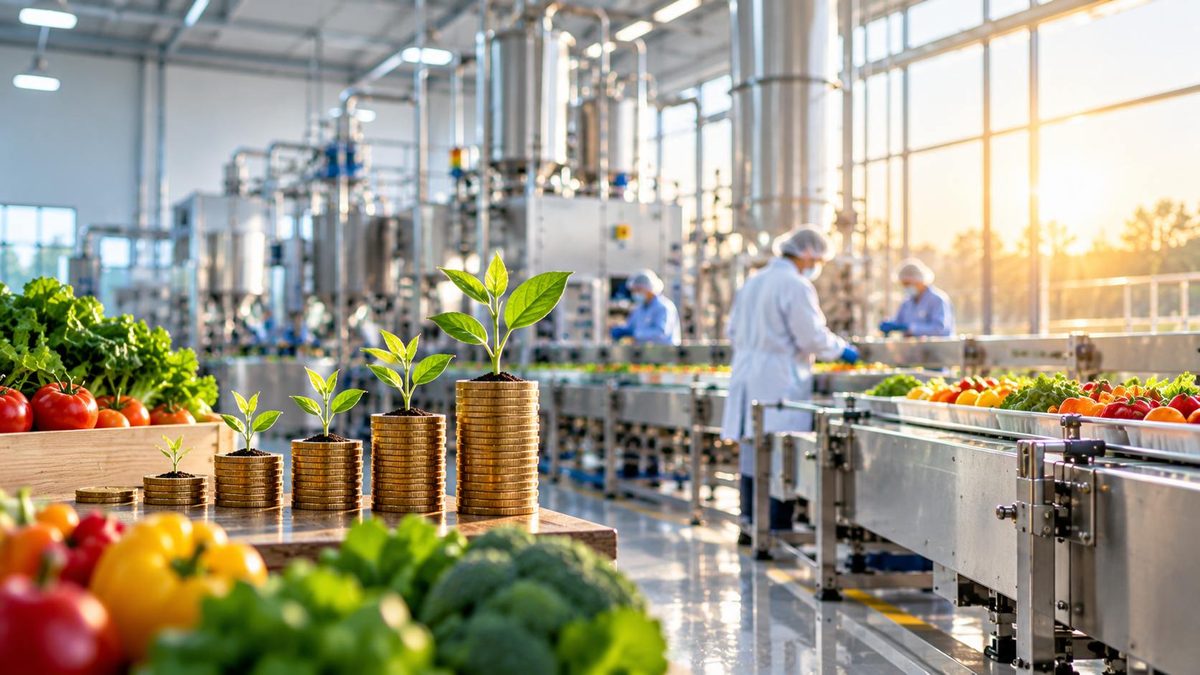
The Ministry of Food Processing Industries (MoFPI) runs India's most important capital-subsidy schemes for the food processing sector. If you are planning a new unit, a cold chain, or a processing cluster, understanding these schemes is the difference between funding your project at 35–50% government support — or missing out entirely. This guide breaks down what is available in 2026 and how to claim it.
What is MoFPI and why it matters
MoFPI is the central ministry driving India's food processing growth. It channels grants through three flagship umbrellas: PMKSY (Pradhan Mantri Kisan SAMPADA Yojana), PMFME (PM Formalisation of Micro Food Processing Enterprises), and PLISFPI (the Production Linked Incentive scheme). Together they cover everyone from a single micro unit to a large manufacturer scaling exports.
The main MoFPI schemes at a glance
PMFME offers a 35% credit-linked capital subsidy up to ₹10 lakh for micro food processing units, FPOs and SHGs. The Unit Scheme (CEFPPC) under PMKSY gives 35–50% grant-in-aid up to ₹5 crore for individual processing units. Integrated Cold Chain and Agro-Processing Clusters each offer 35–50% up to ₹10 crore. Operation Greens supports perishable value chains, and PLISFPI rewards manufacturers with incentives on incremental sales. See our full subsidy schemes page for exact ceilings and eligibility.
Who is eligible?
Eligibility depends on your entity type (proprietor, company, FPO, SHG, cooperative), your product, your location, and your project cost. Units in the North-East, Himalayan states and other notified difficult areas usually qualify for the higher 50% rate. A key rule for most schemes: the subsidy is credit-linked, so a bank term loan must be sanctioned first.
The DPR is your foundation
Every application stands or falls on the Detailed Project Report (DPR) — the techno-economic document covering your technical plan, project cost, means of finance, and financial projections. Banks use it to sanction your loan and the ministry uses it to approve your grant. Most rejections trace back to weak or wrongly-costed DPRs. This is where professional help pays for itself.
How to apply — step by step
In practice the journey is: (1) assess feasibility and pick the right scheme; (2) prepare a bankable DPR and financial model; (3) secure a bank term loan; (4) file the scheme application on the relevant portal; (5) obtain in-principle approval; (6) implement the project; and (7) claim the final grant release after commissioning. Each step is milestone-driven and document-heavy.
How we help
Alliance Global Consulting has delivered 125+ food processing and agro-infrastructure projects across 20+ states. We map every scheme you qualify for, prepare the DPR, coordinate the bank tie-up, and manage approvals through to grant release. Talk to our team for a free eligibility assessment.